There are stories of coincidence and chance, of intersections and strange things told, and which is which and who only knows? And we generally say, "Well, if that was in a movie, I wouldn't believe it." - Magnolia

10.6.13

Review: Stoker

Fox Searchlight/Scott Free Productions/Indian Paintbrush
WARNING: possible spoilers ahead! I'll try not to give plot specifics, but in discussing this film's merits, I may drop one hint too many.

That being sad, Stoker is what so many explorations into the mind of a mentally deranged killer wishes they could be. Many TV shows and movies attempt to saturate the viewing experience in the mind and gruesome deeds of a killer, but in all the stories that I've seen, each becomes wrapped up in the psychology or bloody details without fully realizing the potential of the medium of film. Sure, tricks of editing, effects, and cinematography may be used to try and put the audience in the mind of the killer or at the scene of the crime. Yet in the end, the most common result is something to scare, gross out, or appease those who get a kick out of the sight of violence or the idea of those who could and are driven to do such things. While Stoker follows some of these same devices, the technique used pays off more than the story and literal acts themselves to make for an extremely visceral and sensual experience.

Rather than relying entirely on violence, director Chan-wook Park continually attacks and simulates the senses throughout the entire film through an incredibly detailed sound design, cinematography, and editing. For those familiar with Park's Korean films, you know just how shocking this director can be in his technique. Park's Oldboy, Sympathy for Lady Vengeance, and Sympathy for Mr. Vengeance are some of the most disturbing, impacting films I've ever seen. Unlike Stoker, these films depict some extremely violent material. As his American film debut, Park retains the same techniques from these films in Stoker but eliminates most of the violence

4.6.13

Review: Upstream Color

erbp
During the production of a short film for a 48 Hour Film Festival I participated in back in April, the friends who were working on the project with me and I agreed wholeheartedly that films should be about the image. The story doesn't have to be strong, the main focus, or even make that much sense as the long as the images are technically and aesthetically pleasing and masterful. Part of the reason why we tended to all agree on this idea may have been that we didn't write anything for the film we were making at the time and working purely off of locations and scenarios that we thought were cool or certain shots that we liked. Through the magical process of editing, the film came together quite nicely and, while not making complete sense or having an obvious structure or narrative, we found most people telling us how they found the rhythm and visuals captivating.

I'm willing to bet Shane Carruth, writer, producer, director, editor, star, and composer of Upstream Color had a similar goal in mind when he made this film. Seemingly lacking in chronology, narrative arc and character motivation and development, Upstream Color dives right into the abstract and bizarre. Some of the early sequences and shots are reminiscent of a sort of David Cronenberg type horror and suspense which leaves the audience grasping for a handhold to reality somewhere but failing to find any. For those familiar with Carruth's first film, Primer, a smart, intricate sci-fi drama, it soon becomes obvious that Carruth is once again relying on the collision of seemingly unrelated scenes that begin to form connections and weave together a compelling, dark mystery.

25.5.13

Review: Mud

Lionsgate
Dewitt, a dry, dirty, small town in Arkansas. The deep American south. Lower class families living along the Mississippi river make a living by selling fish out of coolers from the back of old pickup trucks or sifting through junk on the bottom of the river hoping to find something of value. This is the setting for writer/director Jeff Nichols' 3rd film which follows two 14 year-old boys who help out with their family's business and in their spare time explore the great Mississippi River in a dingy old motorboat. On one such adventure they go to discover a boat stranded up in a tree on an island in hopes of making it their own but find a stranger has beaten them to it. He's got long matted hair, tanned, dirty skin with a snake tattoo winding its way down his right arm. He asks for their help in getting him some food, and when asked his name, he replies "Mud. You can call me Mud."

The tale of youths discovering a stranger on an island in the Mississippi should be familiar to most people who had to read Huckleberry Finn in high school. Nichols' was and is definitely influenced by the likes of Mark Twain and other American authors when he made this film. I'd say, with his first two films Shotgun Stories and Take Shelter, Nichols is establishing himself as the Cormac McCarthy of film. His quiet, focused style is honest and straightforward and with carefully controlled bursts of emotion and action. His settings in the Midwest and Southern areas of the U.S. evoke not only Twain but John Steinbeck and Walt Whitman. He recalls the heart of America and themes that such authors as these have written about over the past two hundred years.

19.5.13

Review: Star Trek: Into Darkness


It took 4 years, but J.J. Abrams (Super 8, Star Trek) finally got around to giving us a sequel to the highly successful, and great, 2009 reboot of the Star Trek franchise. Over the past 5 years or so (or even further back if you count his involvement with the TV show Lost) Abrams has become a name associated with high quality Sci-Fi cinema outings and is quickly becoming ranked next to and favored by the likes of Steven Spielberg. Abrams even admitted that Spielberg had a hand in convincing him to accept the director's chair for helming the next Star Wars film recently purchased by Disney which plans to expand the new saga from a galaxy far far away into a new trilogy beginning in 2015. On top of this, Abrams has had his hand in many a project over the past 4 years as producer or director in the case of Super 8. Still, with the success of the first Star Trek, you would think that Paramount would've put more pressure on getting around to making the next Star Trek.

In this case, it seems no one was in any hurry and decided to use the long wait to drum up as much hype as possible. The fast-rising star of Benedict Cumberbatch (Sherlock, War Horse, The Hobbit) mixed with the rumor of the return of Star Trek super-villain Khan increased the size of the expectant audience which was already enlarged by the first film beyond just Trekkies. Suffice to say, Abrams had a much bigger fan-base to please this time around.

13.5.13

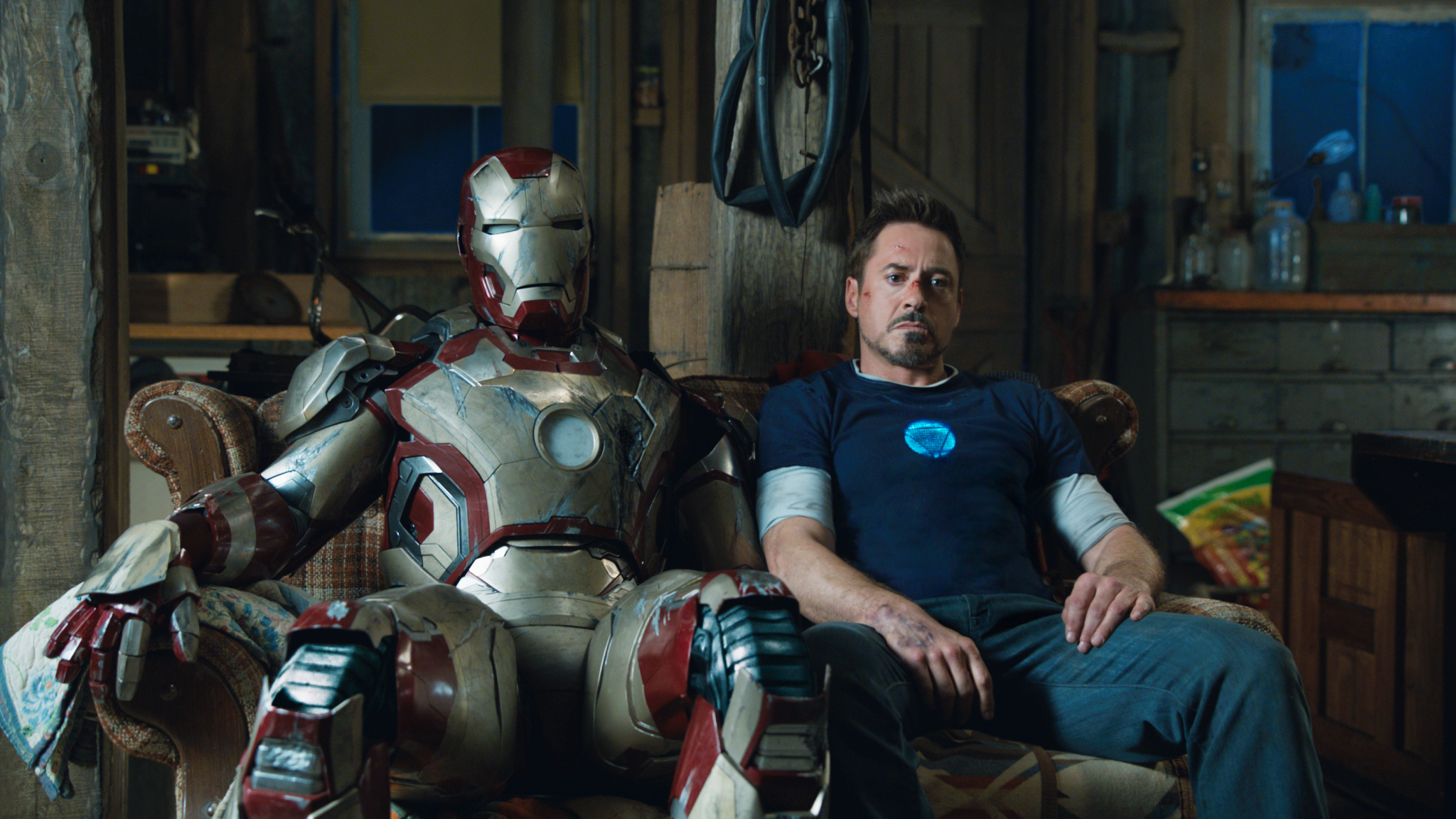
Review: Iron Man 3


I think that Iron Man 3 will be remembered as one of the greatest successes of film marketing in movie history. It wasn't the brilliance of the marketing in any specific way, but rather the sheer reach and presence. For anyone who watched TV, accessed the internet, or went anywhere in the last few months, you know what I'm talking about. In his keynote speech at the San Francisco International Film Festival last month, Steven Soderbergh referred to the marketing strategy as "carpet bombing." A tactic studios use to make audiences believe that a movie is going to be an enormous event that should not be missed. After seeing incessant ads, trailers, and posters for it everywhere, the only option left for citizens of the world to forget about this thing is by seeing it. In that regard, Iron Man 3 was a huge success. It now stands as the 2nd highest grossing film of all time next to The Avengers (produced by Marvel, owned by Disney) with a total gross of $949 million as of 20 hours ago posted by comingsoon.net. Now, the question is, does it deserve such recognition or profit?

The answer is a simple no. It does not. Attempting to be a sort of sequel to The Avengers rather than Iron Man 2 (a poor sequel, in my opinion), Tony Stark (Robert Downey Jr.) is supposed to be going through some sort of crisis. He can't sleep, and he begins to experience panic attacks which all seem to relate to what "happened in New York" with the "worm hole." Stark seems to be suffering from the same thing every super hero goes through eventually: who am I really? The hero or a man? This supposed problem with Stark's identity and finding his real purpose is half-hearted at best and never feels serious enough. The over all lame attempts at comedic relief counter-act any chance at the audience taking Stark's crisis seriously. On top of that, the potentially interesting and genuinely evil character and acts of a terrorist nicknamed "the Mandarin" (Sir Ben Kingsley) come off as out of place and too serious when placed alongside the rest of the film. What you get is a muddling of attempts at character development and focusing a plot that end up fighting each other for the spotlight. The audience is unsure of what to make of the human elements at play in the midst of loud, blinding action scequences.

25.4.13

Review: Trance (2013)


  Director Danny Boyle (Trainspotting, Slumdog Millionaire) has a fantastic eye for editing, cinematography, and sound. Watching one of his movies is like riding a roller coaster through dazzling images and movement. So when it comes to his movies, the characters and stories often don’t matter as much as what you literally see on screen. Not to say that he doesn’t have good stories or characters (one of the best “stories” being Millions, in my opinion), but they generally take a backseat to the look of it all. In the case of Trance, Boyle’s newest film starring James McAvoy, Vincent Cassel, and Rosario Dawson, Boyle doesn’t fail to deliver some fancy shots, editing, and visuals to keep the eyes entertained. Sadly, the story is so blaringly convoluted and unnecessarily complicated that it distracts from everything else.

                The film follows an attempt by Frank (Cassel) and his henchmen to extract a memory from the mind of Simon (McAvoy) using a hypnotherapist, Elizabeth (Dawson). Simon stole a very rare and expensive painting from an art auction but was hit on the head in the process and now can’t remember where he put it. The only route left for them to uncover the location of the painting is through Elizabeth which leads to many opportunities for blending, warping, and mixing up reality from fiction in sequences which depict what Simon and others see during hypnosis. Obviously this provides Boyle a hay-day of chances for cool editing tricks and camera shots, and you get some. For the first 30 minutes or so, the story is rolling right along and everything is feeling OK and like a smarter-than-usual heist movie. But then things dive off the deep end.

Without going into details, suffice to say, Boyle should’ve stuck with his screenwriter from other successful occasions, Alex Garland (28 Days Later, Sunshine). The story begins to blunder, quickly, from one confusing plot twist to the next, and the editing goes overboard, making it nearly impossible to follow. No doubt this was intentional in seeing how it wraps itself up at the end, but this is just ridiculous. Characters’ motives aren’t clear, and neither are they as characters. Ultimately, the story winds up echoing the message of Memento and others like it: the mind can make itself forget things. Would you rather forget or remember? It is an interesting concept and films like Memento have done it incredible justice. But the overly complex story of Trance overshadows the message, style, and characters. What you’re left with is a bag full of interesting tidbits and ideas, but nothing really comes together. For Boyle, one of my favorite, modern directors, this was very disappointing.

12.4.11

Review: Hanna

Focus Features
Right off the bat there's going to be one thing that divides the audience on 'Hanna', the new action/thriller from director Joe Wright ('Pride & Prejudice', 'Atonement'): how smart of a thriller are you expecting? What even makes a thriller 'smart'? When I think of a 'smart' thriller the first movie that pops into my mind is 'Memento.' 'Memento' is complex and confusing from the beginning, and slowly pieces fall into place and start to make sense. Not to mention the intensity is kept at a fairly good rate throughout the entire film. So, what approach does 'Hanna' take to building/maintaining intensity and establishing the mysterious/complex aspect that is often (if not always) part of 'action thrillers'?

'Hanna' is set up as a sort of chase scenario from the beginning. Once young Hanna (Saoirse Ronan) decides she has received enough training from her father (Eric Bana) and is 'ready' she sets off a beacon that alerts Marissa Viegler (Cate Blanchett), a CIA agent, to the duo's location in the middle of the woods somewhere. Right away, the focus of the film is on why was Erik Heller (Bana) training his daughter to kill Marissa and why does she, in turn, want to kill the two of them? What's more, there's obviously something different about Hanna. Mainly that she's a highly skilled killer who is a CHILD.