An attempt to be helpful when it comes to choosing, describing, and nerding out on movies,
There are stories of coincidence and chance, of intersections and strange things told, and which is which and who only knows? And we generally say, "Well, if that was in a movie, I wouldn't believe it." - Magnolia
13.5.13
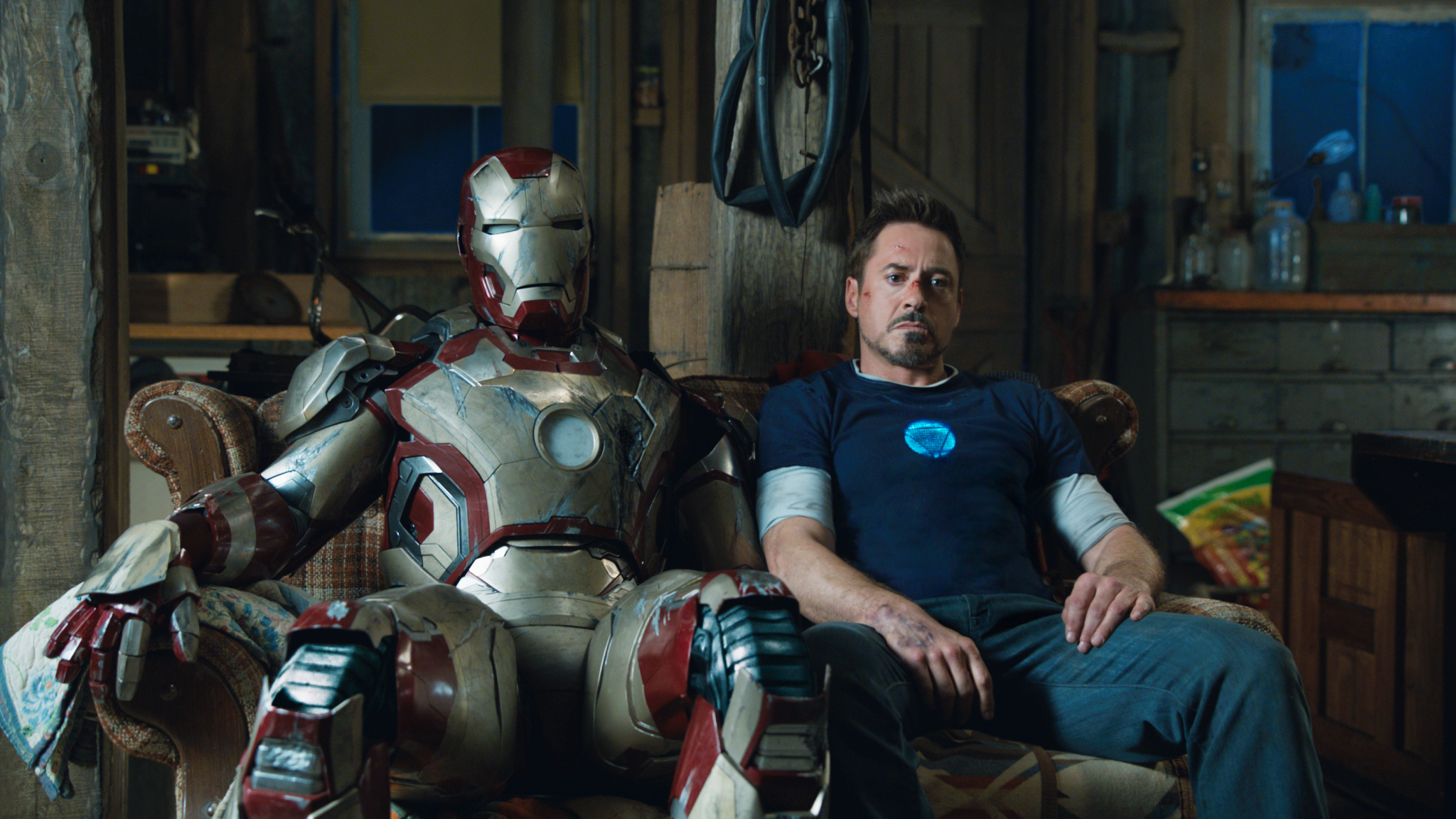
Review: Iron Man 3
I think that Iron Man 3 will be remembered as one of the greatest successes of film marketing in movie history. It wasn't the brilliance of the marketing in any specific way, but rather the sheer reach and presence. For anyone who watched TV, accessed the internet, or went anywhere in the last few months, you know what I'm talking about. In his keynote speech at the San Francisco International Film Festival last month, Steven Soderbergh referred to the marketing strategy as "carpet bombing." A tactic studios use to make audiences believe that a movie is going to be an enormous event that should not be missed. After seeing incessant ads, trailers, and posters for it everywhere, the only option left for citizens of the world to forget about this thing is by seeing it. In that regard, Iron Man 3 was a huge success. It now stands as the 2nd highest grossing film of all time next to The Avengers (produced by Marvel, owned by Disney) with a total gross of $949 million as of 20 hours ago posted by comingsoon.net. Now, the question is, does it deserve such recognition or profit?
The answer is a simple no. It does not. Attempting to be a sort of sequel to The Avengers rather than Iron Man 2 (a poor sequel, in my opinion), Tony Stark (Robert Downey Jr.) is supposed to be going through some sort of crisis. He can't sleep, and he begins to experience panic attacks which all seem to relate to what "happened in New York" with the "worm hole." Stark seems to be suffering from the same thing every super hero goes through eventually: who am I really? The hero or a man? This supposed problem with Stark's identity and finding his real purpose is half-hearted at best and never feels serious enough. The over all lame attempts at comedic relief counter-act any chance at the audience taking Stark's crisis seriously. On top of that, the potentially interesting and genuinely evil character and acts of a terrorist nicknamed "the Mandarin" (Sir Ben Kingsley) come off as out of place and too serious when placed alongside the rest of the film. What you get is a muddling of attempts at character development and focusing a plot that end up fighting each other for the spotlight. The audience is unsure of what to make of the human elements at play in the midst of loud, blinding action scequences.
25.4.13
Review: Trance (2013)
Director Danny Boyle (Trainspotting, Slumdog
Millionaire) has a fantastic eye for editing, cinematography, and sound.
Watching one of his movies is like riding a roller coaster through dazzling
images and movement. So when it comes to his movies, the characters and stories
often don’t matter as much as what you literally see on screen. Not to say that
he doesn’t have good stories or characters (one of the best “stories” being Millions, in my opinion), but they
generally take a backseat to the look of it all. In the case of Trance, Boyle’s newest film starring
James McAvoy, Vincent Cassel, and Rosario Dawson, Boyle doesn’t fail to deliver
some fancy shots, editing, and visuals to keep the eyes entertained. Sadly, the
story is so blaringly convoluted and unnecessarily complicated that it
distracts from everything else.
The
film follows an attempt by Frank (Cassel) and his henchmen to extract a memory
from the mind of Simon (McAvoy) using a hypnotherapist, Elizabeth (Dawson).
Simon stole a very rare and expensive painting from an art auction but was hit
on the head in the process and now can’t remember where he put it. The only
route left for them to uncover the location of the painting is through Elizabeth
which leads to many opportunities for blending, warping, and mixing up reality
from fiction in sequences which depict what Simon and others see during
hypnosis. Obviously this provides Boyle a hay-day of chances for cool editing
tricks and camera shots, and you get some. For the first 30 minutes or so, the
story is rolling right along and everything is feeling OK and like a
smarter-than-usual heist movie. But then things dive off the deep end.
Without going into
details, suffice to say, Boyle should’ve stuck with his screenwriter from other
successful occasions, Alex Garland (28
Days Later, Sunshine). The story begins to blunder, quickly, from one
confusing plot twist to the next, and the editing goes overboard, making it nearly
impossible to follow. No doubt this was intentional in seeing how it wraps
itself up at the end, but this is just ridiculous. Characters’ motives aren’t
clear, and neither are they as characters. Ultimately, the story winds up
echoing the message of Memento and
others like it: the mind can make
itself forget things. Would you rather forget or remember? It is an interesting
concept and films like Memento have
done it incredible justice. But the overly complex story of Trance overshadows the message, style,
and characters. What you’re left with is a bag full of interesting tidbits and
ideas, but nothing really comes together. For Boyle, one of my favorite, modern
directors, this was very disappointing.
12.4.11
Review: Hanna
![]() |
| Focus Features |
Right off the bat there's going to be one thing that divides the audience on 'Hanna', the new action/thriller from director Joe Wright ('Pride & Prejudice', 'Atonement'): how smart of a thriller are you expecting? What even makes a thriller 'smart'? When I think of a 'smart' thriller the first movie that pops into my mind is 'Memento.' 'Memento' is complex and confusing from the beginning, and slowly pieces fall into place and start to make sense. Not to mention the intensity is kept at a fairly good rate throughout the entire film. So, what approach does 'Hanna' take to building/maintaining intensity and establishing the mysterious/complex aspect that is often (if not always) part of 'action thrillers'?
'Hanna' is set up as a sort of chase scenario from the beginning. Once young Hanna (Saoirse Ronan) decides she has received enough training from her father (Eric Bana) and is 'ready' she sets off a beacon that alerts Marissa Viegler (Cate Blanchett), a CIA agent, to the duo's location in the middle of the woods somewhere. Right away, the focus of the film is on why was Erik Heller (Bana) training his daughter to kill Marissa and why does she, in turn, want to kill the two of them? What's more, there's obviously something different about Hanna. Mainly that she's a highly skilled killer who is a CHILD.
9.4.11
Review: Source Code
![]() |
| Summit Entertainment |
With the release of 'Moon' in 2009 I not only gained much more respect for Sam Rockwell as an actor, but also for the film's director, Duncan Jones. 'Moon' proved that Jones has a knack for handling both the tension and progression of stories; especially in the sci-fi genre. Within this genre it's so easy to let the effects, action, and spectacle take over and you lose any sort of connection to the audience and the characters as human beings. It's easy to understand since sci-fi mainly revolves around the science (duh), technology, and fascination with the undiscovered (often UNdiscoverable) elements of the galaxy and the limits of human life and perception. Thanks partly to Rockwell's strong performance as Sam in 'Moon', Jones was able to keep the focus trained on Sam as a human being. The emptiness and seclusion of Sam's position and predicament revealed towards the end only succeeds to emphasize his character and not the 'sci-fi' elements. It makes for a very fascinating movie visually but also emotionally.
So has Jones done it again with 'Source Code', the new sci-fi thriller starring Jake Gyllenhaal? I'd say he has. While the overall tone of the film is quite different from 'Moon', it succeeds on multiple levels of tension, twists, and most importantly, character development.
28.3.11
Review: Of Gods and Men
![]() |
| Why Not Productions/Armada Films/France 3 Cinema/Canal + |
This is a time when I'm really thankful for the way Europeans, specifically the French, make movies. Unlike Americans who have the attention span of an ADD five-year old, the French tend to take their time in movies. They don't care if Americans call it 'slow' or whatnot, it's all about the pacing, telling the whole story, and getting it right. That's something director Xavier Beauvois understands very well, and it was especially important for the making of 'Of Gods and Men.'
In Algeria, in the mid 1990's, fundamentalist terrorist groups began attacking at different locations around the country, specifically targeting foreigners. A few such instances occur near the monastery of Tibhirine where a group of Trappist monks live alongside a Muslim community. They give the villagers medical aid and grow all of their own supplies and sell honey they make in the market. Other than helping the villagers, the brothers spend their time studying, praying, singing, and eating together. Beauvois' handling of the material and the cinematography of Caroline Champetier perfectly capture the simplicity, commitment, and quietness of the monks life. Lead by brother Christian (Lambert Wilson), the monks must decide whether to stay with the villagers the monastery has cared for for decades or flee from the growing danger of the terrorists.
Review: The Adjustment Bureau
![]() |
| Universal Pictures |
Something that is immediately strange about this movie is that it isn't a remake or sequel to anything. Sure, it's "based" on a Philip K. Dick story like every other science fiction movie ever made, but it's still something new coming out of Hollywood. So why was Hollywood willing to put money into a project that is generally unfamiliar to most people? Sure, Matt Damon is a draw for a lot of people and Emily Blunt is a good-looking, talented actress, but is that enough the world of today where most movies are rehashed material?
It seems to me that the premise of the story that a secret organization known as the "Bureau" is controlling life on earth is nothing new to anyone. Whether it's God, angels, lizard people, the illuminati aliens, whatever, many people believe in some force like fate that directs and governs life. Therefore, it's a safe bet that the audience will connect with this movie on some level. But is the massive appeal a good sign for someone who is looking for an intriguing, intelligent time at the movies?
In most cases, movies with universal, obvious messages are terrible or at best mediocre. And even if a movie is generally intelligent in the layout of the plot the revealing of the message at the end is usually something stupid like the ending to many indie movies that usually goes something like "we just have to learn to love in this crazy world." With a question of fate or free-will which 'The Adjustment Bureau' blatantly poses in the trailers and the film itself is the execution of the story or conclusion more important?
27.3.11
Review: Jane Eyre
![]() |
| Focus Features |
It's hard to believe I haven't seen a movie in theaters since 'The King's Speech.' And now, with spring break, it was inevitable that I'd see a movie or two. We'll see if I get to the other two I saw ('The Adjustment Bureau', 'Of Gods and Men'), but for now I'll start with this timeless, Bronte classic that has been adapted to screen countless times over the span of some 100 years; basically ever since making movies became a thing.
So how does it hold up against all the others? It's hard for me to say for sure since I've only seen one version that BBC did a while back that is quite good and is like 3 hours long or something which makes it a lot easier to cover a lot of material. That's probably something this movie accomplished better than any other movie adaptation could have. Jane Eyre (Mia Wasikowska) had a sad, troubling childhood and many things happened to her while leading up to her job as governess to the little French girl at Thornfield Hall, and the film did a great job of capturing it all in just a few scenes. The most important thing being capturing Jane's resilient nature and strong will. Mia Wasikowska definitely picked this role well if she was looking to work on her capabilities as a leading actress, and I think she will most likely be an Oscar contender at some point in the future if this performance tells us anything.
Subscribe to:
Posts (Atom)