There are stories of coincidence and chance, of intersections and strange things told, and which is which and who only knows? And we generally say, "Well, if that was in a movie, I wouldn't believe it." - Magnolia

25.5.13

Review: Mud

Lionsgate
Dewitt, a dry, dirty, small town in Arkansas. The deep American south. Lower class families living along the Mississippi river make a living by selling fish out of coolers from the back of old pickup trucks or sifting through junk on the bottom of the river hoping to find something of value. This is the setting for writer/director Jeff Nichols' 3rd film which follows two 14 year-old boys who help out with their family's business and in their spare time explore the great Mississippi River in a dingy old motorboat. On one such adventure they go to discover a boat stranded up in a tree on an island in hopes of making it their own but find a stranger has beaten them to it. He's got long matted hair, tanned, dirty skin with a snake tattoo winding its way down his right arm. He asks for their help in getting him some food, and when asked his name, he replies "Mud. You can call me Mud."

The tale of youths discovering a stranger on an island in the Mississippi should be familiar to most people who had to read Huckleberry Finn in high school. Nichols' was and is definitely influenced by the likes of Mark Twain and other American authors when he made this film. I'd say, with his first two films Shotgun Stories and Take Shelter, Nichols is establishing himself as the Cormac McCarthy of film. His quiet, focused style is honest and straightforward and with carefully controlled bursts of emotion and action. His settings in the Midwest and Southern areas of the U.S. evoke not only Twain but John Steinbeck and Walt Whitman. He recalls the heart of America and themes that such authors as these have written about over the past two hundred years.

19.5.13

Review: Star Trek: Into Darkness


It took 4 years, but J.J. Abrams (Super 8, Star Trek) finally got around to giving us a sequel to the highly successful, and great, 2009 reboot of the Star Trek franchise. Over the past 5 years or so (or even further back if you count his involvement with the TV show Lost) Abrams has become a name associated with high quality Sci-Fi cinema outings and is quickly becoming ranked next to and favored by the likes of Steven Spielberg. Abrams even admitted that Spielberg had a hand in convincing him to accept the director's chair for helming the next Star Wars film recently purchased by Disney which plans to expand the new saga from a galaxy far far away into a new trilogy beginning in 2015. On top of this, Abrams has had his hand in many a project over the past 4 years as producer or director in the case of Super 8. Still, with the success of the first Star Trek, you would think that Paramount would've put more pressure on getting around to making the next Star Trek.

In this case, it seems no one was in any hurry and decided to use the long wait to drum up as much hype as possible. The fast-rising star of Benedict Cumberbatch (Sherlock, War Horse, The Hobbit) mixed with the rumor of the return of Star Trek super-villain Khan increased the size of the expectant audience which was already enlarged by the first film beyond just Trekkies. Suffice to say, Abrams had a much bigger fan-base to please this time around.

13.5.13

Review: Iron Man 3


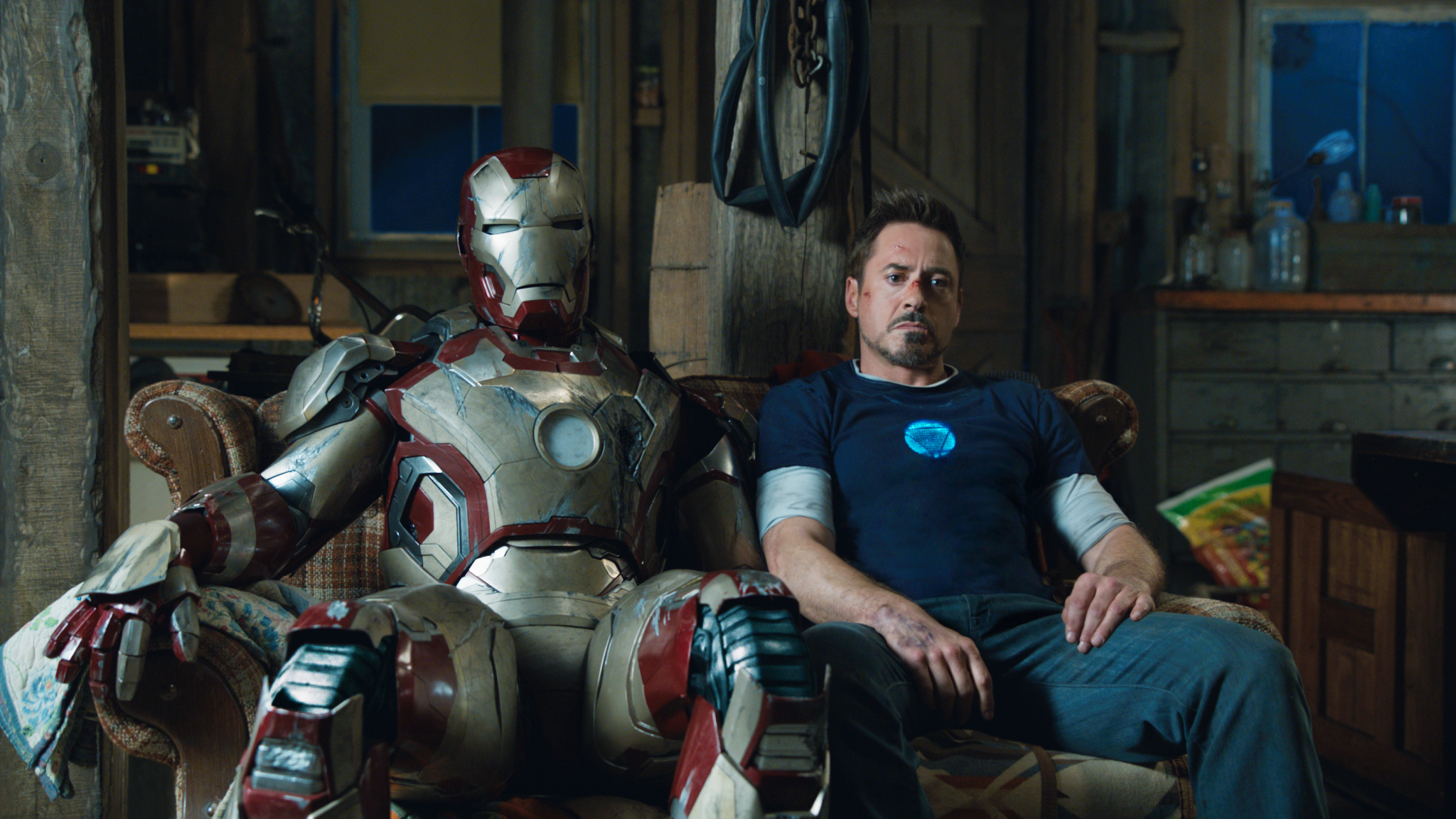
I think that Iron Man 3 will be remembered as one of the greatest successes of film marketing in movie history. It wasn't the brilliance of the marketing in any specific way, but rather the sheer reach and presence. For anyone who watched TV, accessed the internet, or went anywhere in the last few months, you know what I'm talking about. In his keynote speech at the San Francisco International Film Festival last month, Steven Soderbergh referred to the marketing strategy as "carpet bombing." A tactic studios use to make audiences believe that a movie is going to be an enormous event that should not be missed. After seeing incessant ads, trailers, and posters for it everywhere, the only option left for citizens of the world to forget about this thing is by seeing it. In that regard, Iron Man 3 was a huge success. It now stands as the 2nd highest grossing film of all time next to The Avengers (produced by Marvel, owned by Disney) with a total gross of $949 million as of 20 hours ago posted by comingsoon.net. Now, the question is, does it deserve such recognition or profit?

The answer is a simple no. It does not. Attempting to be a sort of sequel to The Avengers rather than Iron Man 2 (a poor sequel, in my opinion), Tony Stark (Robert Downey Jr.) is supposed to be going through some sort of crisis. He can't sleep, and he begins to experience panic attacks which all seem to relate to what "happened in New York" with the "worm hole." Stark seems to be suffering from the same thing every super hero goes through eventually: who am I really? The hero or a man? This supposed problem with Stark's identity and finding his real purpose is half-hearted at best and never feels serious enough. The over all lame attempts at comedic relief counter-act any chance at the audience taking Stark's crisis seriously. On top of that, the potentially interesting and genuinely evil character and acts of a terrorist nicknamed "the Mandarin" (Sir Ben Kingsley) come off as out of place and too serious when placed alongside the rest of the film. What you get is a muddling of attempts at character development and focusing a plot that end up fighting each other for the spotlight. The audience is unsure of what to make of the human elements at play in the midst of loud, blinding action scequences.

25.4.13

Review: Trance (2013)


  Director Danny Boyle (Trainspotting, Slumdog Millionaire) has a fantastic eye for editing, cinematography, and sound. Watching one of his movies is like riding a roller coaster through dazzling images and movement. So when it comes to his movies, the characters and stories often don’t matter as much as what you literally see on screen. Not to say that he doesn’t have good stories or characters (one of the best “stories” being Millions, in my opinion), but they generally take a backseat to the look of it all. In the case of Trance, Boyle’s newest film starring James McAvoy, Vincent Cassel, and Rosario Dawson, Boyle doesn’t fail to deliver some fancy shots, editing, and visuals to keep the eyes entertained. Sadly, the story is so blaringly convoluted and unnecessarily complicated that it distracts from everything else.

                The film follows an attempt by Frank (Cassel) and his henchmen to extract a memory from the mind of Simon (McAvoy) using a hypnotherapist, Elizabeth (Dawson). Simon stole a very rare and expensive painting from an art auction but was hit on the head in the process and now can’t remember where he put it. The only route left for them to uncover the location of the painting is through Elizabeth which leads to many opportunities for blending, warping, and mixing up reality from fiction in sequences which depict what Simon and others see during hypnosis. Obviously this provides Boyle a hay-day of chances for cool editing tricks and camera shots, and you get some. For the first 30 minutes or so, the story is rolling right along and everything is feeling OK and like a smarter-than-usual heist movie. But then things dive off the deep end.

Without going into details, suffice to say, Boyle should’ve stuck with his screenwriter from other successful occasions, Alex Garland (28 Days Later, Sunshine). The story begins to blunder, quickly, from one confusing plot twist to the next, and the editing goes overboard, making it nearly impossible to follow. No doubt this was intentional in seeing how it wraps itself up at the end, but this is just ridiculous. Characters’ motives aren’t clear, and neither are they as characters. Ultimately, the story winds up echoing the message of Memento and others like it: the mind can make itself forget things. Would you rather forget or remember? It is an interesting concept and films like Memento have done it incredible justice. But the overly complex story of Trance overshadows the message, style, and characters. What you’re left with is a bag full of interesting tidbits and ideas, but nothing really comes together. For Boyle, one of my favorite, modern directors, this was very disappointing.

12.4.11

Review: Hanna

Focus Features
Right off the bat there's going to be one thing that divides the audience on 'Hanna', the new action/thriller from director Joe Wright ('Pride & Prejudice', 'Atonement'): how smart of a thriller are you expecting? What even makes a thriller 'smart'? When I think of a 'smart' thriller the first movie that pops into my mind is 'Memento.' 'Memento' is complex and confusing from the beginning, and slowly pieces fall into place and start to make sense. Not to mention the intensity is kept at a fairly good rate throughout the entire film. So, what approach does 'Hanna' take to building/maintaining intensity and establishing the mysterious/complex aspect that is often (if not always) part of 'action thrillers'?

'Hanna' is set up as a sort of chase scenario from the beginning. Once young Hanna (Saoirse Ronan) decides she has received enough training from her father (Eric Bana) and is 'ready' she sets off a beacon that alerts Marissa Viegler (Cate Blanchett), a CIA agent, to the duo's location in the middle of the woods somewhere. Right away, the focus of the film is on why was Erik Heller (Bana) training his daughter to kill Marissa and why does she, in turn, want to kill the two of them? What's more, there's obviously something different about Hanna. Mainly that she's a highly skilled killer who is a CHILD.

9.4.11

Review: Source Code

Summit Entertainment
With the release of 'Moon' in 2009 I not only gained much more respect for Sam Rockwell as an actor, but also for the film's director, Duncan Jones. 'Moon' proved that Jones has a knack for handling both the tension and progression of stories; especially in the sci-fi genre. Within this genre it's so easy to let the effects, action, and spectacle take over and you lose any sort of connection to the audience and the characters as human beings. It's easy to understand since sci-fi mainly revolves around the science (duh), technology, and fascination with the undiscovered (often UNdiscoverable) elements of the galaxy and the limits of human life and perception. Thanks partly to Rockwell's strong performance as Sam in 'Moon', Jones was able to keep the focus trained on Sam as a human being. The emptiness and seclusion of Sam's position and predicament revealed towards the end only succeeds to emphasize his character and not the 'sci-fi' elements. It makes for a very fascinating movie visually but also emotionally.

So has Jones done it again with 'Source Code', the new sci-fi thriller starring Jake Gyllenhaal? I'd say he has. While the overall tone of the film is quite different from 'Moon', it succeeds on multiple levels of tension, twists, and most importantly, character development.

28.3.11

Review: Of Gods and Men

Why Not Productions/Armada Films/France 3 Cinema/Canal +
This is a time when I'm really thankful for the way Europeans, specifically the French, make movies. Unlike Americans who have the attention span of an ADD five-year old, the French tend to take their time in movies. They don't care if Americans call it 'slow' or whatnot, it's all about the pacing, telling the whole story, and getting it right. That's something director Xavier Beauvois understands very well, and it was especially important for the making of 'Of Gods and Men.'

In Algeria, in the mid 1990's, fundamentalist terrorist groups began attacking at different locations around the country, specifically targeting foreigners. A few such instances occur near the monastery of Tibhirine where a group of Trappist monks live alongside a Muslim community. They give the villagers medical aid and grow all of their own supplies and sell honey they make in the market. Other than helping the villagers, the brothers spend their time studying, praying, singing, and eating together. Beauvois' handling of the material and the cinematography of Caroline Champetier perfectly capture the simplicity, commitment, and quietness of the monks life. Lead by brother Christian (Lambert Wilson), the monks must decide whether to stay with the villagers the monastery has cared for for decades or flee from the growing danger of the terrorists.